Certified organic doesn't necessarily mean that it's grown organically. Horizon milk for example takes sick cows from feedlot farms(literally), trucks them to a certified organic farm, milks them there, then returns them to the original uncertified farm. They sell the milk as organic. I don't understand why they just can't make the effort to raise them in a healthy way but they will take the effort to transport them. It's really sad.
Whole Foods standards are no longer what they were since their merge. They use to have high standards. They now sell meat from less than reputable sources(as far as the natural consumer is concerned).
I wish that Wholefoods was really focused on truly organic, natural, wholefoods. But if you read labels there are still many items that I don't qualify as wholefoods. The first time I went in there I assumed everything was good for me. But that is what society tends to do with everything. My doctor knows best, my teacher knows all, my banker knows the right investments, my natural grocery store sells only pure foods. But that's not true. We ARE responsible for all our decisions and should make educated ones. But often we go along with a 'professionals' opinion.
Attachment parents, especially, know that doctors are not always right. There are second opinions and tons of research to look to. These professionals are just people, that were taught by other people. Granted they do have a lot of knowledge in their fields and are probably worth talking to. But they are limited to who taught them, and what interested their own research.
I babywear, as well as sell slings. Which means that I'm a professional babywearer in a way. Does that mean that I'm an expert. NO! But I can tell you that there are a lot of people that may consider me to be. I often tell them to attend Kara's babywearing classes because she's the pro. My point is that- yes I babywear, yes I've researched slings and carriers, yes I know a lot about my products, but even with this knowledge I am still limited to my own experiences and subjective research that I've done. I hope that my customers will hear what I teach them, but I hope they will attend Kara's class, research on their own, try different carriers and carries, and learn for themselves.
So how does that get back on topic? I can appreciate the thought of Wholefoods, and I can take classes to learn about organic food. I can do some research. Read labels, look up farms. Maybe call some of them. Take the initiative to fight for my family. Food is one of the greatest impacts of diseases today. The crap that most people eat on a daily basis is greatly impacting their quality of life and they don't have a clue that it's the food. They blame sugar, fat, carbs. But the chemicals, the gmos, the hormones, even pasteurization- which are all suppose to make things better, are killing us.
People don't eat real butter because it's 'fattening' when in fact raw butter actually helps you loose weight because it has high amounts of lipase which is an enzyme that breaks down fat. So people are blinded by following professionals that they trust like the FDA when in fact the FDA has influences such as money and power in mind when they publish information, studies, etc. There is no large company that can be blindly trusted. We have to take responsibility and action ourselves. So grow your own food. Do your research. Call your farmers. Get to know your food providers. It will make a world of difference once you know.
I use to be unknowing when it came to food. And honestly I still have a LOT to learn. But I'm getting there. Transitioning our lives. We went to a restaurant recently and I couldn't eat the beef. I could taste the difference from our free range at home. I honestly couldn't in the chicken but don't have access to a lot of free range chicken so it makes sense. I also couldn't eat my brothers conventional birthday cake the other day because of all the sugar that was in it.
Researching GMOs really took me for a whirl but I won't get into that now. HFCS and soy are things that I try to avoid. We have access to certified organic produce and natural meat now which is nice. Although I can't wait for local produce to be back in season. And I'm learning about the healing properties of wholefoods from friends who have cured their cancers. It's amazing how good food heals.
So my point has been to educate yourself, rely on yourself, and make your own decisions, and to take action in your life. It will make a difference in your life and the life of your family.
Showing posts with label Food. Show all posts
Showing posts with label Food. Show all posts
Friday, March 19, 2010


Tuesday, March 9, 2010
The Traditional Farmer
I spoke with Lee Quaintance this morning from Acme Grain. It was refreshing to hear his enthusiasm of informing people about pure food. He shared with me a few of his observations on the conventional farmer and large companies taking advantage of these farmers.
 The conventional farmer is greatly influenced by the large coop companies and their advice on issues they face. When a farmer's field sprouts up with weeds they ask the professionals what to do. Sadly these professionals make $$ by telling farmers to use the newest biohazard weed killer on the market. The chemical works for all intensive purposes but the after shock to our bodies has caused diseases of epidemic proportions.
The natural farmer, on the other hand, looks at the weeds in a field and gains a better understanding of the land. Dandelions show a calcium deficiency, while cockaburs show an zinc deficiency. The weeds help the farmer know what the land needs to be healthy. A natural farmer knows that you don't need chemicals to grow a strong crop. You need to listen and be aware of what the land is telling you.
 It makes sense logically and scientifically. Our planet has been able to produce food for millions of years without today's chemicals. The organic farmers are growing successfully with truly traditional methods. The conventional farmer is being dumbed down from these traditional practices by coops and chemical companies who are only concerned with the mighty dollar.
As a consumer we can help control these chemical and coop companies. Our money is what they are after ultimately. When we purchase organic food we increase the demand from farmers to produce organically. With a larger organic market farmers have the incentive to grow real food. Use your food dollars to cast your organic vote and transform the conventional farmer to a traditional farmer.
meeting image originally published on http://www.life.com/image/51148400
farmer image originally published on http://www.farmplusfinancial.com/blog/
corn money image originally published on http://deckfamilyfarm.blogspot.com/
 The conventional farmer is greatly influenced by the large coop companies and their advice on issues they face. When a farmer's field sprouts up with weeds they ask the professionals what to do. Sadly these professionals make $$ by telling farmers to use the newest biohazard weed killer on the market. The chemical works for all intensive purposes but the after shock to our bodies has caused diseases of epidemic proportions.
The natural farmer, on the other hand, looks at the weeds in a field and gains a better understanding of the land. Dandelions show a calcium deficiency, while cockaburs show an zinc deficiency. The weeds help the farmer know what the land needs to be healthy. A natural farmer knows that you don't need chemicals to grow a strong crop. You need to listen and be aware of what the land is telling you.

As a consumer we can help control these chemical and coop companies. Our money is what they are after ultimately. When we purchase organic food we increase the demand from farmers to produce organically. With a larger organic market farmers have the incentive to grow real food. Use your food dollars to cast your organic vote and transform the conventional farmer to a traditional farmer.
meeting image originally published on http://www.life.com/image/51148400
farmer image originally published on http://www.farmplusfinancial.com/blog/
corn money image originally published on http://deckfamilyfarm.blogspot.com/
Wednesday, October 28, 2009
KiwiBerries
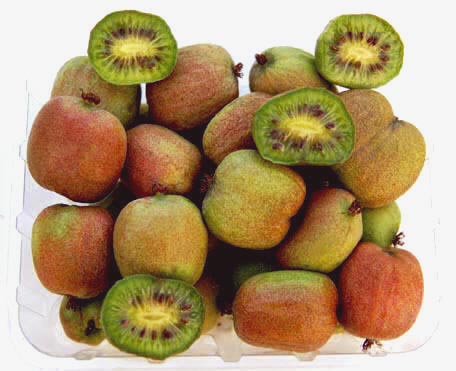
KiwiBerries - unique, organic fruit varieties nurtured by the sun, naturally vine ripened, highly nutritious, rich in antioxidants, and outrageously great tasting. http://www.kiwiberry.com
"KiwiBerries" are a nutritional powerhouse, they are the most nutrient dense of all the major fruits, and are an extremely healthy food source. Containing almost 20 vital nutrients, Kiwi Berries are considered a super fruit! They're not just good for you...they're delicious.
Our berries are higher in nutrient value because we grow them on our modified T-bar trellises where they receive lots of sunshine.
They are rich in antioxidants which are known to reduce the risk of cardiovascular disease, cancer, and help slow the aging process, to name just a few.
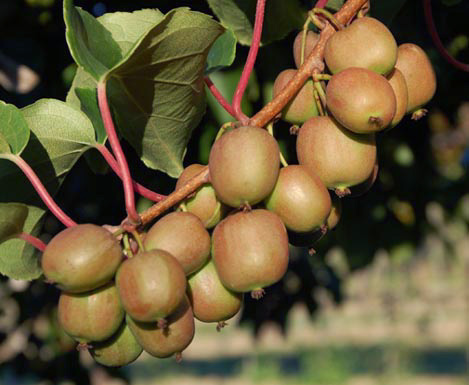
The benefits of these flavorful berries include:
Nutrition Facts |
Serving Size: 6 oz. (170 grams) |
Amount per serving |
Calories 130 Calories from Fat 9 |
% Daily Value * |
Total Fat 1g 1% |
Saturated Fat 0g 0% |
Cholesterol 0mg 0% |
Sodium 0mg 0% |
Total Carbohydrate 30g 10% |
Dietary Fiber 8g 31% |
Sugars 16g |
Protein 2g |
Vitamin A 6% - Vitamin C 120% |
Calcium 10% - Iron 4% |
* Percent Daily Values based on a 2,000 |
calorie diet. Your daily values may be higher |
or lower depending on your calorie needs. |
Calories 2000 2500 |
Total Fat Less than 65g 80g |
Sat Fat Less than 20g 25g |
Cholesterol Less than 300mg 300mg |
Sodium Less than 2,400mg 2,400mg |
Total Carbohydrate 300g 375g |
Dietary Fiber 25g 30g |
Calories per gram |
Fat 9 - Carbohydrate 4 - Protein 4 |
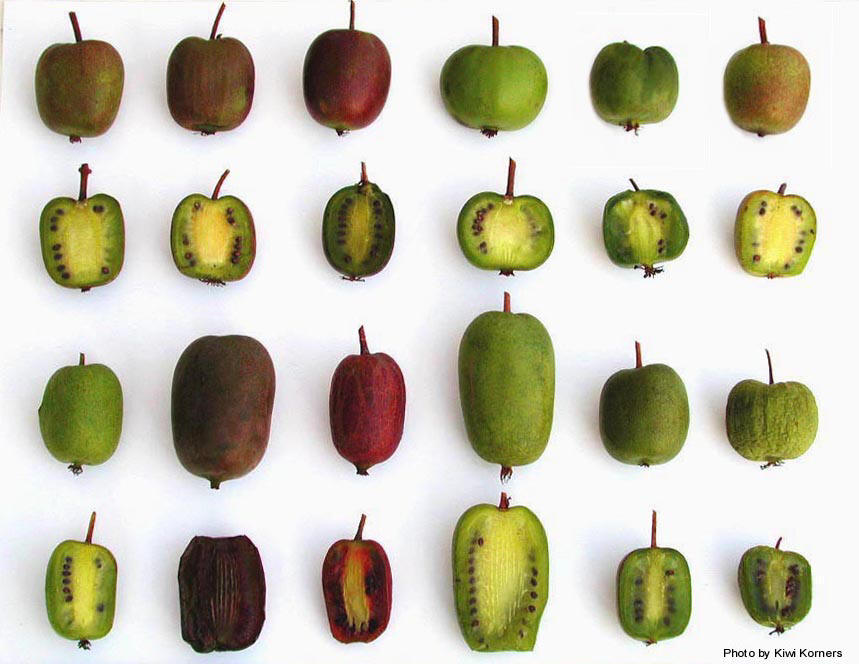
Research from the Kiwi Enthusiasts Journal
The future for kiwi as an important cancer prevention agent seems encouraging in light of recent studies. ( Noburu Motohashi ) Kiwifruit Enthusiasts Journal.
Kiwi is a nutritional powerhouse and an extremely healthy food source. They contain twice the amount of Vitamin E of an avocado fruit, with only 60% of its calories. Kiwi is rich in folic acid, high in fibre, excellent in potassium (higher per ounce than bananas), an extraordinary source of chromium, and have almost no sodium. Some 20 nutrients, all but 3 in meaningful amounts, are contained in this fruit. In this regard kiwi resembles a vegetable more than a fruit, and it may be considered a "super fruit". The Vitamin C content is almost five times that of a medium orange.
The positive elements of these berries are of valuable importance to both health consciousness, and medical benefits as well. In China, Actinidia in general is known as a medicine against cancer. It is said, the Vitamin C, actinidia and 3-Oxy 2- pyranol are efficient in curing cancer. In China people use those fruits as prophylactic medicine and curative medicine.
Kiwi is an ancient Chinese fruit tree indigenous to southern Asia whose popularity has grown since the beginning of this century when it was introduced to New Zealand. Since this time, its use as a traditional Chinese medicament has been investigated and studies of "cancer" records of China reveal that kiwi has been used in anticancer therapy. Recent studies have elucidated two active principles of kiwi, whose modes of action have been investigated. Ascorbic acid, present in relatively great amounts in kiwi, act both directly and indirectly in preventing some types of cancer. It acts directly in the quenching of cancer causing free radicals and the inhibition of the production of carcinogenic N-nitroso compounds. Indirectly, ascorbic acid promotes the production of interferon, and the increased production of "second messengers" such as cyclic-AMAP and cyclic-GMP. Another constituent of kiwi, actinidin protease, acts directly to break down animal proteins in the digestive tract thereby aiding in the digestion of meats. This facilitates improved maintenance of the digestive tract in the defense against cancer.
The overall composition of A. Arguta from a thesis by Philippe Rothgerber published in the Kiwifruit Enthusiasts Journal Vol. 6:
Acidity | 5% dry matter of 1.29% of fresh fruit |
Glucose | 32.6% of dry matter or 8.47% of fresh fruit |
Starch | ( 25% of dry matter) |
Cellulose | ( 15% of dry matter) |
Pectin | ( 5% of dry matter) |
Protein | ( <3% of dry matter) |
Ash | ( only very little) |
Vitamin C | 80mg/100g ( 400 mg% of dry matter) |
Vitamin PP | 55mg/100g |
Provitamin A ( carotin ) | 0.28mg/100g |
Vitamin B1 and B2 |
3 Oxy 2 paranol (a substitute which separates nitrites) |
Actinidin (a ferment [enzyme] which stops coagulation) |


